Wednesday, April 29, 2015

Camper Bunk Bed Poles

Folding Poles for Camper Bunk Beds (by TopLine)
TopLine Folding/Locking Legs
While looking at some camper parts online, I stumbled on a company (TopLine) that makes folding poles of various sizes that can be used for bunk beds. There's obviously a lot of other options for using these (folding table, etc) but the bunk option is the one that's the most interesting to me. Currently my poles are still in fairly good shape but if I need to replace them, I know where to find some now.

Likewise, if you need replacement poles for your bunk or you're looking to add a bunk to your camper. Check out these, they might work. They come in 4 lengths:
  1. 16" [FL3400-16]
  2. 24" [FL3400-24] (should fit the U-hauls)
  3. 27.5" [FL3400-275]
  4. 30.5" [FL3400-305]

You can also see my previous post about pole stability and the post about mods I made to our bunk bed in the U-haul.

Monday, March 30, 2015

18th Century Colonial Market Faire at Fort Yargo State Park

18th Century Colonial Market Faire at Fort Yargo State Park
Every year in the Spring, the Fort Yargo Historical Society puts on their 18th Century Colonial Market Faire at Fort Yargo State Park. I have heard about it but had never been. This weekend we decided to go. We had half the day free and my son didn't have a ball game so we decided to go see what it was all about. Fort Yargo is one of those state parks with tons of things to do: boating, fishing, mountain biking, camping, cabins, yurts, hiking, putt putt, etc. (Fort Yargo is also one of Georgia's First Time Camper Parks which is pretty awesome since there's so much to do there.) I wish we had planned more in advance and taken "CC" over there to camp for the weekend.

Monday, March 23, 2015

Coleman Beach Shade Review (Video)

Coleman Sunshade After our trip to the beach last fall, we decided to ditch the beach umbrella and move to more of a shelter/shade. We looked around and read lots of reviews. We found a good deal at Amazon on the Coleman Beach Shade. So that became one of our Christmas gifts to ourselves. I've been waiting on winter to end and a few days of sun to set it up in the yard and make sure it's all there and that I know how to do it. (I'm a big advocate of putting up a new tent/canopy at home prior to using it on a trip.) Here's a video below of my review and setup of it. More details below the video.

It went up pretty easy. I would say it took me about 10 mins to put it up by myself. It's fairly simple with only 3 poles: 2 black ones that go front to back in a parallel manner, and 1 longer grey one that crosses perpendicular to the black poles. The grey pole took a bit more care to thread through the mesh netting. It didn't slide through like most tents do. When I took it down I had to concentrate on unthreading the grey cross pole carefully too. It's really not that bad though and the first time you do it you will see where the trouble spots that it's likely to get caught are at. I expect to put it up faster in the future now that I know where those are. Due to that, it might be easier to have 2 people to get the grey pole in place and the ends locked into their grommets.

The design seems fairly good. The ends of the poles are tapered a bit to easily fit in the grommets. The grommets seem secure in the webbing at the base. It provides a decent amount of shade considering how small it packs down. Also, you can zip it up totally to make a changing room if you need one (though it might get hot without leaving the doors/windows cracked some for ventilation).

I think it will serve us well. I will follow up with further review after our next beach trip. We might even find other uses for it at other outdoor events.


Monday, March 9, 2015

What is U-haul Camping?

Uhaul camper at 2013 Fiberglass Egg Rally in Townsend Tn
The other day there was a post by another blogger about what type of camping they do. It was an interesting and read and like most things you can categorize camping differently. This author's approach was more about camping lifestyle categories. I would've probably used a different way to categorize camping, but I like the idea of "rural camping" that the author portrayed." Now I'm comfortable with many types of camping even though the rest of my family isn't. As I thought about it more, I realized that most commonly there are three ways to categorize camping: amount of time spent, type of shelter, location.

Amount of Time Spent

So most commonly, you probably hear of campers divided into one of 3 groups:

  • Weekenders - People like us that may take an occasional week long trip. Mostly we do weekends or long weekends amounting to 2-4 nights at a time. 
  • Snowbirds - People who have a camper and move south for the winter. They typically spend a month or more at each campground and go around from one to the next for several months between Dec and March. These folks typically come from up north down to the south to avoid the cold and bad weather hoping for a milder climate.
  • Full-timers - People who live almost exclusively out of their camper. They may visit family or friends sometimes but they typically move from campground to campground all year long. A lot of full-timers do "snowbird" in the south but they don't go home when the ice/snow melts. 

Type of Shelter

Hammock Camping in North Georgia
My Hammock Camping Setup
The other common category is based on the type of shelter and loosely around location too.

  • Tent - Typically includes tent, hammock, or tarp. (I'm including ultra-light hiking/camping here)
  • Camper - Typically involves Popups and Travel Trailers 
  • RVing - Mostly bigger Motorhomes and 5th wheels and maybe some large Travel Trailers
Location

  • Backcountry - These folks typically hike or boat or ride (horse, bike, 4-wheeler) into a remote area and camp. For shelter they carry with them either a lightweight tent, hammock, or tarp.
  • Car Campers - Typically involve a campsite and a tent setup near the vehicle. Can involve camping in vans too. Frequently at campgrounds but not always.
  • Boondocking - Typically a camper or RV in places that don't have hookups and are not a designated campsite with a nice pad, fire ring, or picnic table.
  • Campground - Camping in a designated campground with sites and hookups. 
And you thought you just wanted to go camping. It's good to remember all these differences since what I think of isn't necessarily what you think of. My idea of camping is almost all of the above. The one thing that is not my style is RV'ing. Don't get me wrong. If you want to give up your house and hit the road that's great. Especially if you like to travel and give back by volunteering at different places. But if you have an RV and a house, well that just makes your RV a condo on wheels to me. Not really camping. 

I've done backpacking, tent (car camping), and now camping with a travel trailer. I really do like them all. Right now the U-haul meets a great need for our family. When the kids are older we may add a tent back in to the equation. I'll probably take them backpacking when they're old enough also. I want them to experience all the differences (ok well not the RV with the big screen TV's and leather recliners). 

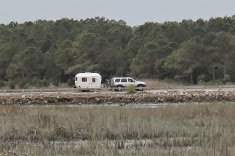
Uhaul Fiberglass Camper crossing the ford at Huntington Beach State Park, SC
So what is our type of camping? To me it's getting out there with the family. Changing up your environment and working with what you have. Meeting new people. Having great meals. Sitting around a campfire relaxing and telling stories/jokes. It's an opportunity to show my kids the great world we live in and take them to places I may not otherwise be able to take them. It's learning about history, nature, and science. Most importantly, it's about making memories as a family.

Why do you camp (or want to)?

Monday, February 16, 2015

Trailer Tires...A Camper's Biggest Friend or Foe

Uhaul Camper Tire Pic
There's a lot to be said about tires for campers. They can make or break a trip. You always want to go through a checklist before a trip. But there's a couple things you need to consider with tires whether you own a trailer or are looking to buy one. The first thing to understand is that trailer tires take more abuse than car tires due to trailer bounce while driving. Also, they sit a lot when not being used. So trailer tires are more likely to dry rot before the tread wears out. So lets talk about two topics related to tires: how to tell the measurements/size you need, and how to tell how old a tire is.

Tire Measurements

There are a lot of numbers/codes on a tire. They all give you some information about the tire itself. Most folks are familiar with something like P225/70 R15 on your car. This is the type and size designation of the tire. P at the beginning stands for P-metric (or passenger car in the US). It's never a good idea to use P-metric tires on a trailer. They aren't designed for trailers and if you put them on a trailer you can't go by the load capacity on the tire. LT (Light Truck) and ST (Special Trailer) tires are typically used on trailers. So you should look for LT or ST for your trailer.

The second part of the code (225 in this example) is the measure in millimeters from sidewall to sidewall of the tire. The third part of the code is the aspect ration which simply means the percentage of the height to the width of the tire. Basically the bigger the number here, the taller the sidewall. R stands for radial (which is most tires today). And the last digit is the wheel/rim diameter that the tire is supposed to fit. There are plenty of information on tire websites that goes into more specifics but that's the basics on tire size. My tires on the U-Haul are ST175/80 R13.
Picture of U-Haul Fiberglass Camper tire size

If you buy an old camper, you may find Bias Ply tires rather than Radial tires. They are sized differently. Your best bet is to take the tire/ or the numbers on the side of the tire to a tire store to get a replacement. Bias ply tires have been phased out over the years in favor of the softer ride of radials.

How old is my tire?

uhaul camper tire coversKnowing the age of the tire is just as important as looking at the tread (especially for those of you buying a camper who may have to drive it a ways to get home). If you want to know the gritty specifics on why tires dry rot, ask your friend who took chemistry in college or Google it. Basically, think of old rubber bands, The oils and chemicals in the rubber break down and some evaporate over time and the rubber gets more brittle. This makes it more prone to cracking and blowouts. A big cause (or accelerator) of this is UV rays from the sun. For those who are new to campers, you probably thought those tire covers on other campers were just for looks or to keep the tires clean. Not really. Veteran RVers know that shielding them from the sun will make them last longer. You may even want to get a cover for that spare tire to make it last longer.

Picture of U-Haul Fiberglass Camper tire date code
All tires, in the US at least, are manufactured with an Tire Identification Number (TIN). The same code is stamped on every tire in a batch. The TIN is the code after the DOT part on the tire. as you can see in the picture on the right from my tire. What we care about is the last 3 or 4 digits on the tire. For tires made before 2000, there will be 3 digits at the end, for those made after 2000 it's 4 digits. So right away if I bought a camper with there being 3 digits only at the end of the TIN, I'd go get a new tire. For those made after 2000, the 4 digit code is easy to read, the last 2 digits are the year the tire was manufactured. That will tell you how old the tire is. (The preceding 2 digits are the week of the year.) So in my example to the right, This tire (my spare) was made during the 16th week of 2012 (1612).

So now you know how check your tires. I can't stress how important this is for those buying used or vintage campers to look at the dates on the tires. When I bought our U-Haul fiberglass camper, the tires on the camper were decent age but the spare was a bias ply that was probably 20-25 yrs old. I replaced that the first week as my very first "project" on the camper. I just wasn't comfortable trusting that spare if I needed it. Oh and always carry a spare! If you are buying a camper and it doesn't have a spare tire, then I'd recommend trying to find one before you go on a trip.

I hope this helps some of you. Feel free to drop me a line or comment below if you have any questions.